 ქართული
 русский
5 Common Mistakes: What to Watch Out for When Installing a Fire Safety System
5 Mistakes in Fire Safety System Installation
Choosing quality equipment for a fire safety system is only the first step. If the installation or configuration is not carried out correctly, the system may fail to perform as intended. Poorly planned or poorly executed work can interfere with the system's proper operation and significantly reduce its effectiveness in the event of a fire.
Below are 5 common mistakes that deserve particular attention during fire safety system installation.
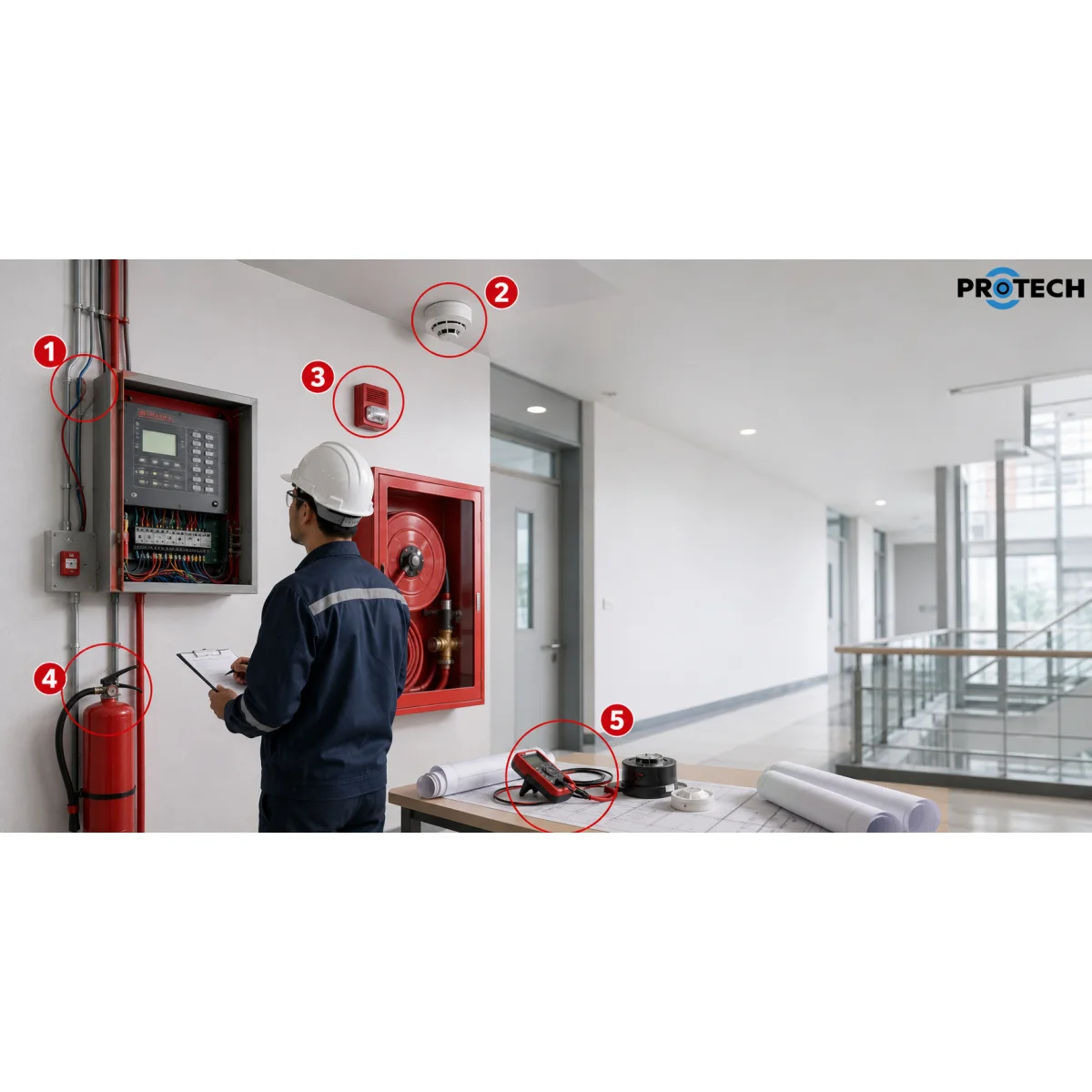
1. Using non-fire-resistant cables
Using non-fire-resistant cables in fire safety systems is one of the most serious mistakes. During a fire, such a cable may stop functioning, causing the fire alarm panel to lose communication with detectors, sounders, or other system components.
As a result, the system may fail to perform its main function. This is precisely why, when selecting cables for a fire safety system, it is essential to consider their compliance and fire resistance.
2. Incorrect detector placement and spacing
The number and placement of detectors must be determined according to the characteristics of the facility and the applicable requirements. In practice, there are cases where fewer detectors are installed than required, or the spacing between them does not meet established standards.
In such cases, timely detection of a fire may become more difficult, and the system may fail to provide full coverage of the space. For this reason, detector layout must be determined based on the specifics of the facility and a properly developed design.
3. Using incompatible or low-quality equipment
Every component of a fire safety system — the panel, detectors, sounders, modules, and other devices — has its own function and technical requirements. Using mutually incompatible or low-quality components can lead to malfunctions in the system's operation.
Therefore, when selecting equipment, it is important that the devices meet the system's requirements and are compatible with one another. The quality of individual components alone is not enough — what matters is that all devices work reliably together as a single system.
4. Incorrect installation and configuration
Even high-quality equipment cannot ensure proper system performance if its installation or configuration is not carried out correctly. Improper cable routing, incorrect component connections, or inadequate panel programming can all cause malfunctions.
For this reason, installation work must follow the requirements set out in the design, and every component must be correctly mounted, connected, and configured.
5. Neglecting testing and periodic maintenance
Completing the installation of a fire safety system does not mean that inspection is no longer necessary. Before the system is put into operation, its performance must be checked and tested to confirm that all components are working properly.
Periodic technical maintenance is equally important. Over time, a component may become damaged or faulty, which affects the system's performance. Regular inspection makes it possible to identify and correct such problems in good time.
Conclusion
Even a seemingly minor mistake made during the installation of a fire safety system can have a significant impact on its effectiveness. Selecting the right cables and equipment, positioning detectors correctly, and ensuring proper installation and configuration are all essential to reliable operation. Periodic technical maintenance is no less important, so that any fault in the system is identified and corrected in time.
Ultimately, the reliability of a fire safety system does not depend on equipment quality alone. What matters is that the system is installed correctly, tested, and inspected periodically by a specialist.